
Don't Let Lower Rates Drive Big Decisions

-
 August 3, 2026
Lower interest rates won't solve the biggest challenge facing most Illinois grain farms today: tight margins.
Corn and soybean prices have moved lower from recent highs, while many input costs remain elevated. In an environment where profitability is under pressure, borrowing decisions matter more than they have in several years.
Many producers are still waiting for interest rates to move lower. While that may eventually happen, successful farms cannot rely on future rate cuts to make today's decisions work. Federal Reserve projections and market expectations suggest interest rates may remain above the ultra-low levels farmers became accustomed to during the 2010s and early 2020s. Recent Fed projections show policymakers expect rates to remain near current levels through the remainder of 2026, reinforcing the idea that producers should plan around today's borrowing costs rather than yesterday's rates.
For corn and soybean producers, that makes borrowing decisions more important than they have been in several years.
The Challenge Isn't Just Interest Rates
A few years ago, strong commodity prices helped offset rising expenses and borrowing costs. Today, the equation looks different.
Corn and soybean margins have tightened. Meanwhile, many costs including seed, crop protection products, machinery, labor, and cash rent remain well above pre-pandemic levels.
In other words, the challenge facing many farms today isn't simply higher interest rates. It's the combination of tighter margins and higher borrowing costs.
Don't Build a Plan Around Lower Rates
It is always tempting to believe relief is right around the corner.
Unfortunately, interest rate forecasts can change quickly. Just a year ago, many market participants expected a faster pace of rate cuts than what ultimately occurred. As producers know, making long-term decisions based on forecasts can be risky.
That's why major investments should work at today's borrowing costs, not the rates we hope to see in the future.
Before purchasing machinery, improving grain facilities, or buying farmland, consider the following questions:
- Does the investment make sense at today's rates?
- Can the operation support the payment if crop prices remain under pressure?
- Will the investment improve efficiency, profitability, or long-term competitiveness?
If the answer depends on future rate cuts, it may be worth taking another look.
A Real-World Example
Consider a central Illinois grain farm evaluating a machinery replacement.
The farm plans to finance an additional $500,000 over seven years. Depending on the rate and structure, annual principal and interest payments may range from roughly $85,000 to $95,000.
If interest rates fall by 0.50% or even 1.00%, the payment would decline somewhat. But that reduction alone is unlikely to turn a marginal investment into a great one.
The more important question is whether the investment improves the operation enough to justify the cost. Will it reduce repairs? Improve efficiency? Reduce labor requirements? Increase profitability over time?
The same principle applies to land purchases and facility expansions.
Another important consideration is that a good investment should stand on its own merits under today's borrowing costs. If rates move lower in the future, that can certainly improve the economics of the investment. Farm Credit Illinois also offers repricing options on many eligible loans, allowing borrowers to take advantage of lower rates if market conditions change. That means producers do not necessarily have to delay a sound business decision while waiting for rates to fall.
It's Not Just the Rate. It's the Loan Amount.
When producers talk about borrowing costs, the conversation often focuses on interest rates.
However, the amount borrowed frequently has a larger impact on total interest expense than the rate itself.
A producer borrowing $1 million at 6% will generally incur substantially more interest expense than a producer borrowing $500,000 at 7%.
Interest rates matter. But managing the amount of debt taken on may have an even greater impact on long-term profitability.
Looking Ahead
No one knows exactly where interest rates will be a year from now.
What we do know is that successful farms make major investment decisions based on sound economics, not hopes for lower rates.
In Part 2, we'll look at another key factor in today's farm economy: why working capital, liquidity, and financial flexibility may be even more important than the next move by the Federal Reserve.
Until then, we continue to live in some truly INTEREST-ing Times.
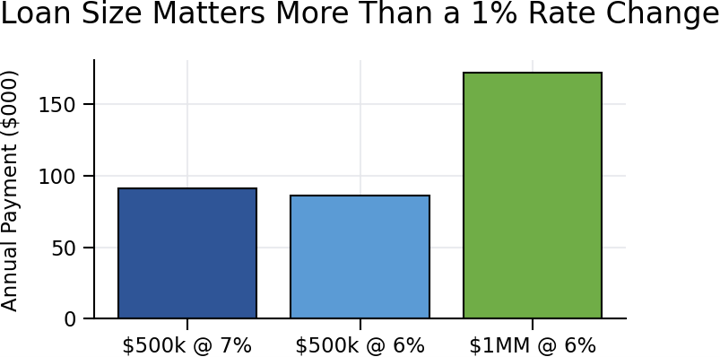
Figure 1. Loan Size Matters More Than a 1% Rate Change
